Paul Poon (65) 8181-7777


Paul Poonsiriwong
(65) 8181-7777
Top Achievers 2005-2007,
Asia Pacific Elite Award 2007,
TopGun Academy 2005,
Million Dollars Club,
Prime District Realtor,
Commercial Realtor,
New Projects Realtor,
B.Arch.,Dip in Comp.Sc.,CEHA
Agency Licence:
L3002382K
CEA Licence:
R027740E

Websites:
www.i-lander.net
www.expatcondo.com
www.paulpoon.biz
www.singaporeoffice.net

Micro Sites
 
 
*all sites are optimized for iPhone

TAGS: singapore, prime, cheap, freehold, condo for sale, condo for rent, condominiums, condos, apartment for sale, apartment for rent, condos rental, apartments rental, in singapore


Bookmark


SINGAPORE PROPERTY NEWS & UPDATES

 
Summary: Due to Singapore Economy Recovery, specially after Q1 2010 Report. Property Market in Singapore is experincing strong upturn, high volumn of transactions, price of properties are on the rise. New Launch Projects, specially new condo for sale are having hot sale. 
 
by editor's team 12-May-10

Resale prices of private homes continue to rise

posted Jun 28, 2011 12:23 AM by Poon Paul   [ updated Jun 28, 2011 12:45 AM ]

Resale prices of private homes continue to rise

SINGAPORE: Resale prices of private homes continue to rise in the second quarter of this year. 

According to DTZ Research, resale prices of private residential properties increased at a faster rate across all segments in the second quarter of this year compared to the first. 

It says the average resale price of leasehold condominiums in the suburban areas rose the fastest by 3.9 per cent on-quarter, compared to 0.8 per cent in the first quarter.;

The average resale price of freehold condominiums in the prime districts of 9, 10 and 11 grew by 3.3 per cent on-quarter compared to 0.4% per cent in the first quarter, based on a basket of completed condominiums tracked by DTZ Research.

The average resale price of luxury condominiums rose the least at 1.7 per cent.

But DTZ Research said it reflected an increase over the flat prices registered in the first quarter. 

This it said is the only segment with prices still below the 2007 peak.

Ms Chua Chor Hoon, Head of DTZ South East Asia Research, said prices continue to trend upwards because sellers are benchmarking against the prices of new launches.


- CNA/fa


http://www.channelnewsasia.com/stories/singaporelocalnews/view/1137625/1/.html

URA releases flash 1st quarter 2011 private residential property price index

posted Mar 31, 2011 11:11 PM by Poon Paul


The Urban Redevelopment Authority (URA) released today the flash estimate of the price index of private residential property for 1st Quarter 2011.

Based on the estimated price index of private residential property, prices rose from 194.8 points in the 4th Quarter 2010 to 198.8 points in the 1st Quarter 2011. This represents an increase of 2.1%, compared with 2.7% in the previous quarter (see Annex A). The rate of price increase has moderated for 6 consecutive quarters, since 4th Quarter 2009.

URA also released today the flash estimates of the price changes in the 3 geographical regions for 1st Quarter 2011. Prices of non-landed private residential properties increased by 0.9% in Core Central Region, 2.2% in Rest of Central Region and 3.1% in Outside Central Region in the quarter (see Annex B). In comparison, for 4th Quarter 2010, prices of non-landed private residential properties increased by 2.2% in Core Central Region, 1.9% in Rest of Central Region and 2.1% in Outside Central Region.

The flash estimates are compiled based on transaction prices given in caveats lodged during the first ten weeks of the quarter supplemented by information on the number of new units sold. The statistics will be updated 4 weeks later when URA releases the full 1st Quarter 2011 real estate statistics, when more data on the caveats lodged and the take-up of new projects are captured. Past data have shown that the difference between the quarterly price changes indicated by the flash estimate and the actual price changes could be significant when the change is small. The public is advised to interpret the flash estimates with caution.


Supply in the Pipeline

As at 4Q2010, there was a total supply of 65,699 uncompleted units from private housing projects in the pipeline.1 Of these, 33,000 units were still unsold. This supply can last for about 3 years based on the historical annual take-up over the past 5 years. This supply also does not take into account new sites that were recently sold2 or will be made available for development through the Government Land Sales (GLS) programme. Prospective home-buyers are advised to take into consideration the ample pipeline supply of private housing, as well as the potential supply of private housing from GLS sites, when making decisions on property purchase.

1 These refer to new development and redevelopment projects with planning approvals, i.e. either a Provisional Permission (PP) or Written Permission (WP).
2 These refer to new projects for which planning approval have not been obtained yet.
 

Arrival of the super-rich in Singapore

posted Nov 15, 2010 4:31 PM by Poon Paul

By Seah Chiang Nee

A luxurious 7,072 sq ft penthouse at a prime district has just changed hands for S$30 million in one of the most expensive deals on a per square foot basis.

The buyer was a permanent resident from Hong Kong and, the seller, an Indian tycoon who had bought it in 2006 for S$17.3 mil (RM41.21mil).

The cost of the triplex with five bedrooms and an 11m swimming pool worked out to S$4,242 per sq ft, a record in land-scarce Singapore.

Last June, an unknown Chinese national snapped up a bungalow on Sentosa Island for S$36 million, the highest paid for a residence here.

The PR holder from China had considered the price a “bargain”, according to the agent who handled the sale.

These are among a rising number of wealthy foreigners – especially Chi­nese, Indians and Indonesians – who have made this city their family residence while doing business outside.

Asia’s growing wealth, particularly from China and India, is slowly making its way into Singapore. More Europeans, too, are parking their money here.

For a glimpse of a Singapore in, say, another 10 or 15 years just take a picture of Monaco or Zurich and superimpose it on this island.

What will emerge is a city of wealth – transient and abiding, a land of personal banking, celebrity-chef dinners, where Bentleys, Lamborghinis and Ferraris ply the street and branded goods will become daily items.

An example of the foreign presence can be gauged at Sentosa Cove, one of Singapore’s most posh and expensive waterfront projects.

More than 3,000 people now live there. They have come from 22 countries, the top five nationalities being Singaporeans (who make up 40%), Australians, Britons, Germans and Chinese.

“Singapore has opened up a lot in recent years and we’re drawing foreigners keen to park their money as well as live here,” a developer said.

The arrival of the nouveau riche has created new fortunes for Sing­apore’s upper middle class, but it has also widened the economic gap between the rich and the poor as few of the lower class derives much benefit from the phenomenon.

For the upper class, the story is clear. Last year the number of millionaires jumped by 26%.

Currently, 11.8% of Singaporean households have at least US$1 mil in investible assets (excluding property) each.

Some recent headlines gave an indication of the change, good and bad.

A Singaporean billionaire, Peter Lim, has just made a US$507 mil bid (since aborted) to buy England’s Liverpool football team.

And two Singaporeans displayed their wealth less gloriously at the casino tables.

One, a company managing director of a seafood business, lost S$26 mil in just three days, while the second, who was in the latest Forbes list of Singapore’s 40 richest people, dropped S$100 mil.

Easy come, easy go!

Cashing in on it, Citibank last week launched an exclusive Ultima credit card for the super rich in Singapore where members must have S$5 mil and admitted only by invitation.

Some of the nouveau riche came because of their children’s education.

Among them is action star Jet Li, who bought a bungalow for S$19.8 mil last year. He took up citizenship and sent daughter, Jane to study here.

Another new settler, US investment guru Jim Rogers, with a net worth of US$1.8 bil, also came to send his daughter to the reputable Nanyang Primary School two years ago. To ensure she got a better chance, Rogers and his wife had performed 40 hours of volunteer work, something the locals do.

Who are the richest foreigners living here?

The Forbes’ list of top 40 ranks China-born Zhong Sheng Jian, 48, as the fourth richest man in Singapore with a net worth of US$2.5 bil.

And 47 year-old Indian-born Sudhir Gupta, now a naturalised citizen is ranked 13th richest. He has a personal fortune estimated at US$320 mil.

Seventeen percent of foreign buyers of high-end property in the first quarter are Chinese, and the number is rising.

One out of five bought houses in prestigious multi-million dollar districts of 9 to 11, the Central Business District (CBD) and Sentosa.

Some salesmen have reported cases of Chinese buyers paying the down payment with a bag of cash, leading to suspicion they may be keen to cover the money trail.

Recently a growing number of foreigners have turned to buying landed properties.

Under the law foreigners, including PRs, cannot buy any property on land or any apartment with fewer than five storeys – except with special approval.

Under its strategy of attracting the wealthy and talented to settle here, the government appears to be loosening the screw.

In the first half of this year, 150 such sales were allowed, most in the prime, rich areas.

Local critics are protesting against such sale of precious landed properties. “It is like selling the country’s Crown Jewels to outsiders,” one blogger wrote.

The influx of foreign wealth is not welcomed by all Singaporeans. Some see their cake becoming smaller and more expensive.

Many of working class citizens living in the heartland do not see much benefit from having so many rich people around – but they feel the pain of rising costs.

A polytechnic student asked: “And what happens to us when they suddenly take their money and go home?”

A former Reuters correspondent and newpaper editor, the writer is now a freelance columnist writing on general trends in Singapore. This post first appeared on his blog, www.littlespeck.com, on October 16, 2010.
 
By yahoosingapore – November 11th, 2010

Private property sales rebound in Oct

posted Nov 15, 2010 3:23 AM by Poon Paul

Sales of private home units rebounded in October, climbing above the 1,000 units level yet again.

Data released on Monday by the Urban Redevelopment Authority (URA) showed that 1,058 private units were sold last month.

Including Executive Condominiums, the total sales would have reached an even more impressive figure of 1,587.

That's higher than the 911 units sold in the previous month.

Chalking up the best sales was Esparina Residences at Buangkok Drive, which sold 425 units.

Sales fell in September after the government imposed property cooling measures that took effect from August 30.

-CNA/wk
 
15 November 2010
channelnewsasia.com

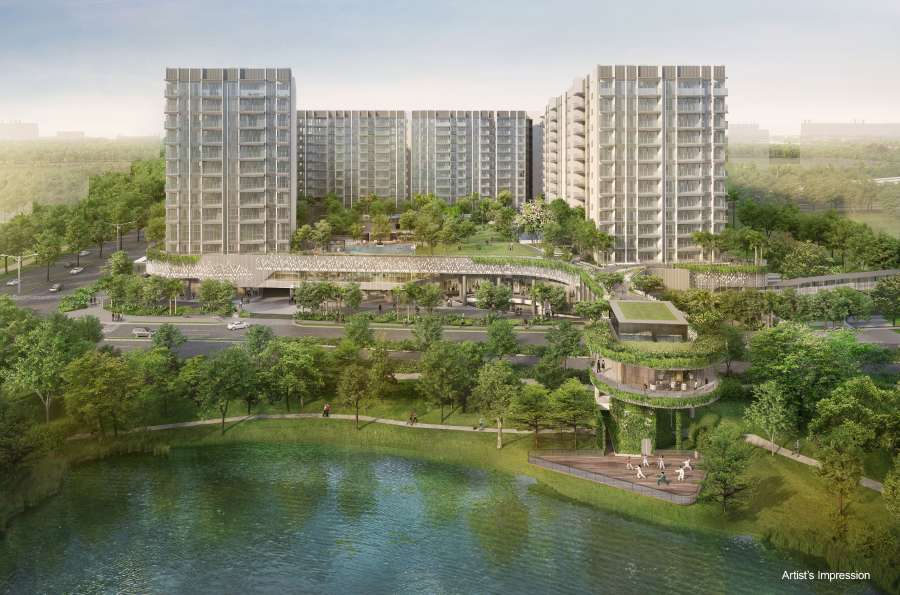
Strong interest for new Lakefront Residences condos

posted Nov 13, 2010 5:09 PM by Poon Paul   [ updated Nov 13, 2010 5:11 PM ]

Keppel Land held a special preview on Friday for The Lakefront Residences - its residential development located in the Jurong Lake District.

The move was met with strong enquiries from local homebuyers and investors, including residents and foreigners from China and Malaysia, the company said.

The property received positive take-up of about 250 units at an average price of approximately S$1,020 per square foot.

This reflects home buyers' confidence in the development's "strong value offerings of a prime location next to the Lakeside MRT station," said Augustine Tan, president (Singapore Residential) at Keppel Land.

The Lakefront Residences will comprise 629 homes, ranging from 1- to 4-bedroom units and penthouses when completed by the end of 2013.

Its location within the Jurong Lake District, which is envisioned to be a commercial, leisure and residential hub, is among the property's main draw for home buyers.

The district will house hotels, shopping and dining facilities, among other things. Two upcoming hospitals in the vicinity are set to be completed in 2014 and early 2015.

Keppel said the transactions are not expected to have any significant impact on the net tangible assets per share or earnings per share of Keppel Land for the financial year ending 31 December 2010. - CNA /ls

Jittery developers go low-rise on confidence

posted Oct 30, 2010 6:02 PM by Poon Paul

34% expect prices of new launches to fall; some fear more cooling measures.

The worst-kept secret in the property market is out in the open. Not only are developers less upbeat about the future but a third of them actually expect prices of new homes to decline. And market performance for the suburban residential sector may be the worst hit.

This dose of pessimism was reflected in the latest readings of Real Estate Sentiment Index (RESI) put out by the developers body and NUS.

In the wake of the Aug 30 cooling measures, some 34 per cent of developers polled for Q3 expect prices for new residential launches to decline, albeit by less than 10 per cent, over the next six months. None of the developers surveyed in Q1 and Q2 had predicted price drops.

Just 44 per cent expect more new residential units to be launched over the next half year, down from 68 per cent in the previous quarter.

The sentiment indices slipped below the psychologically significant mark of 5 in Q3, indicating respondents were less upbeat in the quarter and expect more uncertain market conditions over the next six months.

The consensus as indicated by net balances is generally weaker.

Polled on how the suburban residential sector would perform, the net balance in Q3 was -43 per cent. This means that most expect the sector to perform worse over the next six months. In Q2, this net balance was +27 per cent, hinting at better future performance.

'The strong historical price growth in the sector is not likely to be sustained moving forward. Downward adjustment to the price growth, if it occurs in the next few months, will ease some pressure on the affordability level of mass-market residential properties in suburban areas,' said Associate Professor Sing Tien Foo of NUS.

The net balance for the future market performance of the prime residential sector, while still in positive territory, has also been declining significantly, from +54 per cent in Q1 to +32 per cent in Q2 and +3 per cent in Q3.

About 70 per cent of the developer respondents in the latest survey were concerned that the government could intervene to dampen the property market further.

They also cited other factors that could hurt sentiment over the next six months. The concerns included a slowdown in the global economy (cited by 60 per cent), an increase in the supply of development land (53 per cent), too many new property launches (49 per cent), rising interest rates (47 per cent) and tightening financing/liquidity in the debt market (40 per cent).

Eighty-four per cent of all survey respondents consider it likely and very likely that there will be a further increase in the supply of development land over the next six months. An even higher proportion, 90 per cent, of respondents expect the government to further boost the supply of Build-to-Order and Design, Build and Sell Scheme public housing flats as well as executive condo (EC) units.

Recent government steps to cool the market are expected to have most impact on the HDB resale and mass private housing market segments. About 76 and 64 per cent respectively of survey respondents rated their impact on these two market segments over the next six months as significant. Conversely, the measures are expected to have the least impact on the high-end/luxury segment with 64 per cent predicting minimal impact. For the mid-end private housing segment, 79 per cent foresee only moderate impact.

Real Estate Developers' Association of Singapore and NUS' Department of Real Estate polled slightly over 70 respondents for their latest Q3 survey, similar to the size for the Q1 and Q2 surveys.

The Current Sentiment Index, where respondents are asked to rate overall Singapore real estate market conditions now compared with six months ago, fell from 5.8 in Q2 to 4.8 in Q3.

The Future Sentiment Index, where respondents rate overall property market conditions over the next six months, also slipped from 5.9 in Q2 to 4.8 in Q3. As a result, the Composite Sentiment Index (the average of the two indices), also declined to 4.8. The index ranges from 0 to 10 with a score below 5 indicating deteriorating market conditions.

Redas CEO Steven Choo said: 'The RESI was able to track closely the immediate impact the cooling measures has on sentiments in the property sector.'

Agreeing, Knight Frank chairman Tan Tiong Cheng said: 'The findings are not surprising. Just look at the amount of land government has been releasing and the supply of new HDB flats and ECs they're planning, plus the demand-side measures. People have put on their thinking caps to figure out how they'll be affected, whether they are HDB upgraders, buying a second/investment property, or even downgrading.

'The latest survey results are a clear signal to government that the measures are having an impact,' he added.

Separately, the NUS' Institute of Real Estate Studies yesterday released its monthly Singapore Residential Price Index tracking prices of completed non-landed private homes. The overall index rose one per cent month on month in September, slightly slower than the 1.1 per cent increase in August.

NUS' sub-index for Central region, which covers a basket of properties in districts 1-4 and 9-11, increased 0.6 per cent in September, the same pace as in August. The sub-index for Non-Central region appreciated 1.4 per cent in September, slightly slower than the 1.6 per cent gain posted in August.

Sun, Oct 31, 2010
The Business Times

By Kalpana Rashiwala

Unemployment rate falls in Singapore

posted Oct 29, 2010 1:28 AM by Poon Paul

Singapore's unemployment rate has fallen further.

At the end of September, it was 2.1 per cent, down from 2.2 per cent in June.

The Manpower Ministry (MOM) said among the resident labour force, the unemployment rate was 3.1 per cent, also down by 0.1 percentage point.

It said in its preliminary estimates for the third quarter, total employment has grown by 24,100 in the quarter.

This brought total employment growth in the first nine months of the year to 85,500, compared to a flat growth of 100 in the corresponding period of last year, due to the global economic downturn.

MOM said the employment creation came primarily from the services sector, which added 24,100 workers in the quarter.

Construction employment rose marginally (100) due to the completion of major building projects earlier in the year.

Manufacturing employment continued to fall (-400), though the decline eased from the previous quarter (-2,300).

MOM said based on preliminary estimates, 1,400 workers were retrenched and 500 had their contracts terminated prematurely, resulting in a total of 1,900 workers made redundant in the third quarter.

This was lower than the 2,280 workers made redundant in the second quarter.

With the pick up in the economy, redundancy in manufacturing fell to 900 from 1,220 in the previous quarter.

Services laid off 900 workers, about the same as the previous quarter.

Construction displaced 100 workers, compared with 150 in the second quarter of 2010.

-CNA/wk
www.channelnewsasia.com
29 October 2010

Singapore receives 18.4% more visitors in Sept on-year

posted Oct 29, 2010 1:27 AM by Poon Paul   [ updated Oct 29, 2010 1:32 AM ]

The Singapore Tourism Board (STB) said Singapore received 947,000 visitors in September.

That's 18.4 per cent more visitors compared to the year-ago month.

It was also the highest number of arrivals received in the month of September and marked the 10th consecutive month of record visitor arrivals.

STB attributed the performance to the Formula One Grand Prix and the draw of the many leisure and entertainment events under the Grand Prix Season Singapore 2010.

Visitor days were estimated at 3.8 million, a year-on-year growth of 17.5 per cent.

Visitors from Indonesia, Malaysia, Australia, China, and India accounted for almost 60 per cent of total visitor arrivals.

Hotels also recorded higher room revenue and occupancy.

-CNA/wk
www.channelnewsasia.com

29 October 2010

Secondary home sales shrink under big chill

posted Oct 28, 2010 3:03 AM by Poon Paul

Secondary market transactions of private homes slowed down considerably in September over the preceding month following the property cooling measures announced on August 30.

The number of subsales fell about 52 per cent month on month in September, while resales of private homes eased 42 per cent over the same period, an analysis of URA Realis caveats data as of Oct 19 shows.

The sales volumes are expected to increase over the next few weeks as more caveats are lodged for September's transactions. Nevertheless, market watchers reckon the preliminary numbers shown in the analysis by Credo Real Estate is an indication of the slowdown of activity in the secondary market for private homes following the government measures.

Sat, Oct 23, 2010
The Business Times

By Kalpana Rashiwala

Private residential prices rise 2.9% in Q3

posted Oct 22, 2010 4:13 AM by Poon Paul   [ updated Oct 22, 2010 4:15 AM ]

Singapore's measures to cool the property sector had a stronger effect on prices in the private housing segment in the third quarter than initially estimated.

Final data released on Friday by the Urban Redevelopment Authority (URA) showed that overall private residential prices rose 2.9 per cent from the second quarter, slowing sharply after a gain of 5.3 per cent in the previous three months.

URA's initial estimate was for a 3.1 per cent increase in prices in the third quarter.

URA data showed that although prices rose more slowly than in any of the previous four quarters, they still climbed to a new record.

Prices of landed properties bucked the downtrend, increasing by 7.7 per cent in the third quarter, compared with a 6.2 per cent gain in the previous quarter.

Rents of private residential properties rose 3.6 per cent in the third quarter, lower than the 5.9 per cent increase in the April-June period.

New launches and take-up rates were also affected by the cooling measures.

A total of 3,501 uncompleted private homes were launched in the third quarter, down from the 4,180 units in the previous three months.

As many as 3,561 uncompleted private homes were sold last quarter, a drop from the 3,955 units sold between April and June.

22 October 2010
channelnewsasia.com

1-10 of 143